Friday, May 4, 2012

histo, blasto, coccidiomycosis

This is a very common USMLE topic....

Coccidiomycosis: "cough and bumps" - pneumonia, bumps (nodules) on legs (aka Dessert bumps)
California, dessert areas

Blastomycosis: "cough and blasts"- pneumonia, ulcers and warts, may be disseminated to kidneys, liver, brain etc
Decomposing leaves, wooded areas,

Histoplasmosis: "gives no history" -Asymptomatic in many. (Serious in HIV),
Mississippi, Missouri,Ohio etc, Bat droppings, caves


All can present with granuloma in the lungs


Thursday, May 3, 2012

A-a gradient

A- Alveolar pO2
a-Arterial pO2
A= 150-1.2(pCO2)

A-a gradient: (normal is 5 to 15)
What is the difference in the amount of oxygen getting into the lungs and that getting from the lungs into the blood?
Answer= A-a gradient
Higher if there's :
Impaired diffusion at alveolar level e.g pulmonary edema,  thickened alveolar membrane 
Abnormal ventilation/perfusion ratio :
  • Decreased alveolar perfusion (shunt)-Pulmonary embolus
  • Decreased alveolar ventilation (dead space)- obstructive diseases, ARDS (Atelectasis/alveolar collapse)
Right to left shunt (blood by passes the alveoli, goes straight back to left side of the heart without getting oxygenated)


Obstructive or Restrictive lung disease


Obstructive
Low FEV1, normal FVC
Low FEV1/FVC ratio

High Residual Vol


Restrictive
Low FEV1, Low FVC

High or normal FEV1/FVC ratio
Low Residual Vol

Wednesday, May 2, 2012

Thyroid CA

Most common : Papillary

Papillary: good prognosis, spread to nodes, slow growing, hx of exposure to radiation (head & neck), Tmt:  surgery , Give T3, T4 to suppress TSH

Follicular: distant spread (heamatogenous),

Medullary: Associated with familial syndromes e.g MEN 2a & 2b, produce calcitonin

Anaplastic: worst prognosis,  no metastases, Focal growth, palliative tmt


A non functioning (normal TSH) thyroid nodule is more likely to be malignant if:

  • history of head & neck radiation
  • Male gender
  • Older person
  • lymph nodes present
  • cold nodule on thyroid scan

You MUST do a FNA for every euthyroid nodule:
if  malignant do surgery,
if benign, do nothing
if follicular, it may be benign or malignant, FNA can't differentiate so treat as malignant- do surgery.

MEN 2b

MuMP

Mucosal neuroma
Medullary CA of thyroid
Phaeochromocytoma


Marfanoid habitus, GI symptoms

MEN 2a

PaMP


Parathyroid hyperplasia
Medullary CA of thyroid
Phaeochromocytoma

MEN1

Pi, Pa, Pa

Pituitary
Parathyroid
Pancreatic


(PiPaPa, PaMP and MuMP: MEN1, 2a and 2b)

Hashimoto's thyroiditis

Auto immune, chronic thyroiditis

fibrosis

Anti microsomal Abs

Hypothyroidism (may have very mild hyperthyroidism initially)

Graves or subacute thyroiditis ?

Both have symptoms of hyperthyroidism
Both have elevated T4 T3, Low TSH


However,
Radioactive iodine uptake, RAIU:
high in Graves, Low in subacute (De Quervain) thyroiditis

Thyroid palpation:
Tenderness in subacute thyroiditis
no tenderness in Graves

Opthalmopathy:
Only in Graves

ESR:
high in subacute thyroiditis


Mgt decision:
Subacute thyroiditis is transient (can occur post partum), only supportive care- Aspirin
Graves requires definitive tmt.

Thyroid storm

Emergency

Triad of : Altered mental status +fever + high output heart failure in a patient with history of previous Graves disease (hyperthyroidism).

The sudden exacerbation is precipitated by stressful event e.g surgery, trauma, infection etc.

Can also occur due to sudden release of preformed thyroid hormones during radioiodine therapy.

Graves disease

Auto immune (TSH receptor antibodies)

Goitre- diffuse

Hyperthyroidism (most common cause is Graves dx)

Ophthamopathy(only in Graves)

hyperthyroid sympoms : wt loss , tremors, heat intolerance, diarrhoea, palpitations, menstrual irregularities, bruit over goitre, may have pretibial myxedema , proximal muscle weakness (can occur in both hypo and hyper) etc.

High T3, T4, low TSH (primary hyperthyroidism)

High radioiodine uptake (same for toxic nodule)

Tmt:
Acute phase
  1. Propanolol or Atenolol
  2. Propylthioracil or methimazole
continue until patient is euthyroid

Definitive treatment
  • Radioactive iodine (kill the thyroid)
continue until patient is hypothyroid, then
  • thyroid replacement therapy


Note:
proptosis may worsen with tmt
Agranulocytosis may occur with PTU or Methimazole, monitor wbc.
if patient c/o fever, sorethroat etc while on tmt, stop meds and check wbc count
The agranulocytosis is reversible

In pregnancy,
Acute phase: low dose propanolol + low dose PTU. Do not use Methimazole in pregnancy
Definitive: Surgery in 2nd trimester. Do not use radio iodine in pregnancy

Hyperprolactinemia

causes:

  • Prolactinoma
woman with infertility, amenorrhoea, galactorrhoea (usually microadenomas in females so no pressure symptoms)

Man with visual field deficit, headaches etc (usually macroadenoma in males so there r pressure symptoms)

  • Primary hypothyroidism
Increased TRH stimulates excess prolactin production

  • Drugs:
Dopamine antagonists (antipsychotics), SSRIs, TCAs, methyldopa, metochlopromide
Dopamine inhibits prolactin secretion so its antagonists remove this inhibitory effect

Tmt:

First line for all patients: Bromocriptine

Men with prolactinomas(macroadenoma) : surgery or radio

Old women with microadenoma , not concerned about fertility, : no treatment reqrd.

SIADH

Syndrome of inappropriate ADH secretion.
Too much ADH
Too little urine (anti diuretic), highly concentrated urine, reabsorbing too much water, too dilute plasma
Hyponatremia

Causes:
Look out for CNS diseases (CNS tumour, trauma, stroke etc),chronic Lung diseases (Lung tumour, TB) or medications (vincristine, vinblastine)

Tmt:
Treat primary cause
Ristrict water

If no response, induce nephrogenic DI with Lithium or Demeclocycline.

Acromegaly

pituitary tumour secreting GH

GH stimulates prodxn of insulin-like GF (Sommatomedin C) in the liver

Organomegaly

Increase in shoe size, increase in cap size, "can no longer remove wedding ring", coarse facial features, large tongue, body odour, deeper voice, joint pains, snoring, erectile dysfunction (co-secretion of prolactin by tumour)

Remember medscape Alan with Acromegaly . google this.
carpal tunnel syndrome, Obstructive sleep apnoe,  DM/glucose intolerance, Hypertension, Congestive Heart Failure

Most common cause of death is CHF

Initial test: IGF level

Most accurate test: glucose suppression test (GH level post glucose ingestion is abnormally high)


Tmt:
Carbagoline, Bromocriptine,
Octreotide

most respond to surgery.

Radiotherapy if not responsive

Diabetes insipidus

polyuria, polydypsia, can't concentrate urine. Dehydrated, yet producing dilute urine.

Patients feel well until they lose access to water and then become dehydrated because the body is not responding appropriately.

There's hypernatremia with neurological symptoms such as  confusion, disorientation, seizures, lethargy, coma.

ADH can be low(central) or high(nephrogenic)

Do water deprivation test


Treatment:

Central: Give Desmopressin

Nephrogenic:
Treat underlying causes e.g Kidney disease, medications(stop Lithium)
If no improvement, try hydrochlorothiazide! or amilioride! (These diuretics will help lose some salts while patient continues to drink water)

Psychogenic polydypsia

Patient with polydypsia, polyuria and symptoms of hyponatremia- lethargy, confusion, seizures, psychosis, death

Water deprivation test shows an almost normal response. There's a little deviation from normal bcos kidney's concentrating ability is slightly impaired by hyperdilution of the renal medulla.

May be seen in Schizophrenics, children,

positive family history

Tuesday, May 1, 2012

Oral contraceptives and associated risks

OCPs increase risk of

cervical cancer 
breast cancer,
DVT
hypertension.


OCPs reduce risk of

ovarian cancer
endometrial cancer

Remember

Check TSH and T4 in every patient with new atrial fibrillation  
 (? HYPERTHYROIDISM)

Check TSH and T4 in every patient with hyperprolactinemia    
(? HYPOTHYROIDISM)

Check TSH and T4 in elderly patient with sudden dementia + new hypercholesterolaemia +decreased deep tendon reflexes , constipation, weight gain etc
(? HYPOTHYROIDISM)

Pancreatic cancer

Elderly

Painless jaundice (cancer head of pancreas, obstructing bile flow)

Upper abdo  pain, radiating to the back (cancer originating from the body or tail of pancreas)

weight loss

Abdo mass

steatorrhea

+/- pruritus


risk factors: Family history, Elderly, smoking, obesity, DM

Monday, April 30, 2012

Superior vena cava syndrome

Suspect in patient with history and findings suggestive of bronchogenic carcinoma, with

shortness of breath
face or arm swelling
headache
upper chest vein distension
neck vein distension


Due to compression of SVC by tumour

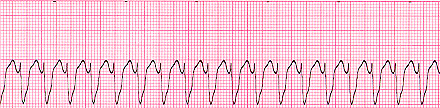
Ventricular tachycardia

Life threatening!

Tachcardia + wide QRS (diff from a specific SVT called wide QRS SVT, however better to consider and treat as VT until proven otherwise)

Causes include electrolyte abnormalities, MI, drugs, long QT syndrome etc

Ventricular Tachycardia


Tmt: Immediate cardioversion-

If stable: Chemical (Amiodarone , Lidocaine) or Sync DC cardioversion

If unstable: has pulse- Synchronised DC cardioversion
                   no pulse - defibrillation


Note:
 Torsades de pointes :

is a different type of VT. The morphology of QRS varies from one complex to the other thus it's refered to as polymorphic VT. 
Caused by anything that can prolong QT interval. culprits include Quinidine, Procainamide, Sotalol, Amiodarone (least likely) etc


Tmt includes Magnesium sulphate infusion first!

Paroxysmal supraventricular tachycardia

Sudden onset palpitation
Dizziness
Chest pain
Dyspnea
+/- LOC

Due to
  • AV node re-entry or
  • AV  re-entry  (av node + accessory pathway)- WPW syndrome
ECG : Tachycardia + narrow QRS, retrograde P wave -right after QRS
File:AV nodal reentrant tachycardia.png

In WPW, there's the Delta wave- slurred upstroke of the QRS with a short PR interval bcos the signal evades the normal AV node delay and rather passes thru the accessory pathway.


Treatment:
Initial: vagal maneouvres (vasalva, carotid massage)

Drug Tmt :
Adenosine to block AV node except for Wolff-Parkinson-White (AV blockers  r contraindicated in WPW becos it'll only promote passage thru accessory pathway.) Amiodarone for WPW

2nd line drugs include verapamil, diltiazem, metoprolol, digoxin

Cardioversion for unstable patients or those not responsive to medications.

Conn Syndrome

Primary Hyperaldosteronism

Hypertension
Hypokalaemia
Muscle weakness

Metabolic alkalosis

Hypernatremia

No edema
Adrenal tumour

Diag: Do Aldosterone/ Renin ratio (>30)

Tmt: Spirinolactone (can cause gynecomastia)
         Eplerenone
         Surgery

Sunday, April 29, 2012

Glucagonoma

Presents like Diabete mellitus with Polyuria, Polydypsia, weight loss, hyperglycaemia but with a necrotizing dermatitis-  necrolytic migratory erythema(blistering and swelling in areas subjected to friction).

Malignant Pancreatic tumour (alpha cells)

Tmt :surgery

Cystic fibrosis

Defective Chloride transport due to defective CFTR gene (usually a 3base pair deletion)
Aut recessive
Thick mucus secretions causing recurrent sinopulmonary infections, bronchiectasis, FTT
Psedomonas causes Pneumonia (Treat with 2 agents with antipseudomonad coverage)
Pancreatic insufficiency leading to Fat malabsorption with deficiency of vitamins A D E and K, Chronic diarrhoea
Meconium ileus (failure to pass meconium, bilous vomitting, history of polyhydramnios, ground glass appearance on X ray, intestinal perforation)

Positive sweat chloride test (done twice) is diagnostic.

Tmt: high calorie diet, pancreatic enzymes replacement, fat soluble vitamins supplementation. Only life saving tmt is bilateral lung transplant.

Median survival is 30yrs

Pyloric stenosis

Congenital
Infant 4-8 wks old with projectile vomitting which has become more frequent and more forceful
Vomittus is non bilous, occurs after feeding
Visible peristalsis in upper abdo
Failure to thrive
Olive shaped upper abdo mass palpable after vomitting (may however be absent)
Abdo USS  confirms diagnosis: shows thick hypoechogenic ring in pyloric area
Tmt: surgery

Intussusception

2yr old Child with abdo pain
presents with features of small bowel obstruction

red currant jelly stool

sausage shaped abdo mass

USS shows target sign (one tube inside another)

Air contast enema both diagnoses and reduces it in most cases

Paediatric Hip joint pain

Slipped capital femoral epiphysis : Obese adolescent male, referred pain to knee usually present, loss of abduction and internal rotation of hip. Tmt: surgical pinning promptly to avoid avascular necrosis.

Legg-Calve-Perthes disease:  child 4-10yrs, male, avascular necrosis of femoral head, idiopathic. Tmt- splint or surgery

Septic arthritis:  Emergency. Acute onset, warm swollen jt, hematogenous spread following URTI, staph & strep,
hip is externally rotated, X ray usually normal,  wbc count is high, ESR is high.
Do USS guided aspiration- synovial fluid leucocyte >100,000 is definitely SA, do culture.
Tmt : drain immediately, empirical antibiotics nafcillin (or vancomycin ) + cephalosporin

Avascular necrosis in sickle cell anemia: African descent, history suggestive of SS

Transient synovitis:  male child 3-10yrs, following trauma or viral infection.

Exclude septic arthritis. if at least 3 of the following are present, do further workup.

Fever>39°C,
WBC >12,000,
ESR >40 ,
 Refusal to bear weight

Kawasaki Disease

Vasculitis following infection
Child less than 5yrs
Hyperaemic buccal mucosa, strawberry tongue, Fissured lips
Diagnosis is clinical
Criteria: High fever (>39°C) for 5 days + 4 of ffing: unilateral large lymph nodes,
                                                                                     rash,
                                                                                    mouth changes,
                                                                                    limb desquamation/edema
                                                                                    conjuctivitis


Tmt: IVIG and Aspirin. (unlike other rashes in children where aspirin is contraindicated cos of risk of Reye's syndrome )

May be complicated by Coronary artery aneurysm with resultant risk of MI.

Young child with fever, red eyes, red tongue, red palms and rash

Guillain-Barré syndrome

Ascending paralysis

albumino-cytologic dissociation in CSF(high protein, normal wbc)

Recent Campylobacter jejuni  or other infection e.g respiratory
Investigations: nerve conduction studies, LP

Risk of death from respiratory failure
Monitor pulmonary function: Peak inspiratory pressure and FVC

Tmt:  IVIG or  Plasmapheresis